A normal button waits for you to click it. A cancellation button apparently has other plans. It hides under vague wording, loses visual weight, sends you through another confirmation screen and, when all else fails, introduces you to someone whose job is to ask whether you have considered not cancelling after all.
That tension is the engine behind Cancel My Subscription, our free satirical browser game about escaping ZenFlix+, a fictional streaming service with an unlimited retention budget. In the first development log, we covered the opening 17 levels: forms, signatures, retention offers, calendar arithmetic, a slot machine and, eventually, cancellation pachinko.
The current development build has now reached Level 23. The new batch asks a different question: what happens when the interface stops being a passive obstacle and actively fights back? The answer is six levels built around confusion, obstruction and persistence. They are exaggerated for comedy, but the instincts behind them are recognisable to anyone who has tried to leave a subscription.
Start the cancellation process yourself. It is free, browser-based and needs no account.
Play Cancel My SubscriptionWhat are subscription dark patterns?
Dark patterns, also called deceptive design patterns, are interface choices that steer, pressure or manipulate people into decisions they may not otherwise make. In a subscription flow, that can mean hiding important information during sign-up, preselecting the option that benefits the business, making the cancellation route more difficult than registration, or repeatedly presenting reasons to stay.
This is not a niche complaint. A 2024 sweep coordinated by the International Consumer Protection and Enforcement Network examined 642 subscription traders across 26 countries. It reported that 75.7% used at least one dark pattern and 66.82% used multiple patterns. The report describes obstruction as making a task more difficult or tedious, and notes that most traders in the sweep that provided cancellation information made cancelling substantially harder than enrolling. You can read the ICPEN subscription dark-pattern report for the full findings.
A cross-country study of online newspaper subscriptions found a similar imbalance: cancelling required more clicks than subscribing in every country tested, with the US cancellation routes taking roughly twice as many clicks. Researchers also encountered promotional offers, mandatory surveys, lengthy bot conversations and even a request to type the word "Cancel" into a box. Maynooth University summarises the research into difficult online subscription cancellations.
Our levels are not a scientific taxonomy and ZenFlix+ is not a real company. Some mechanics directly echo documented patterns; others take the same basic incentive and sprint into absurdity. The point is not that a real streaming service literally makes its button run away. The point is that, emotionally, it sometimes feels as though it does.
Level 18: plan confusion becomes a shell game
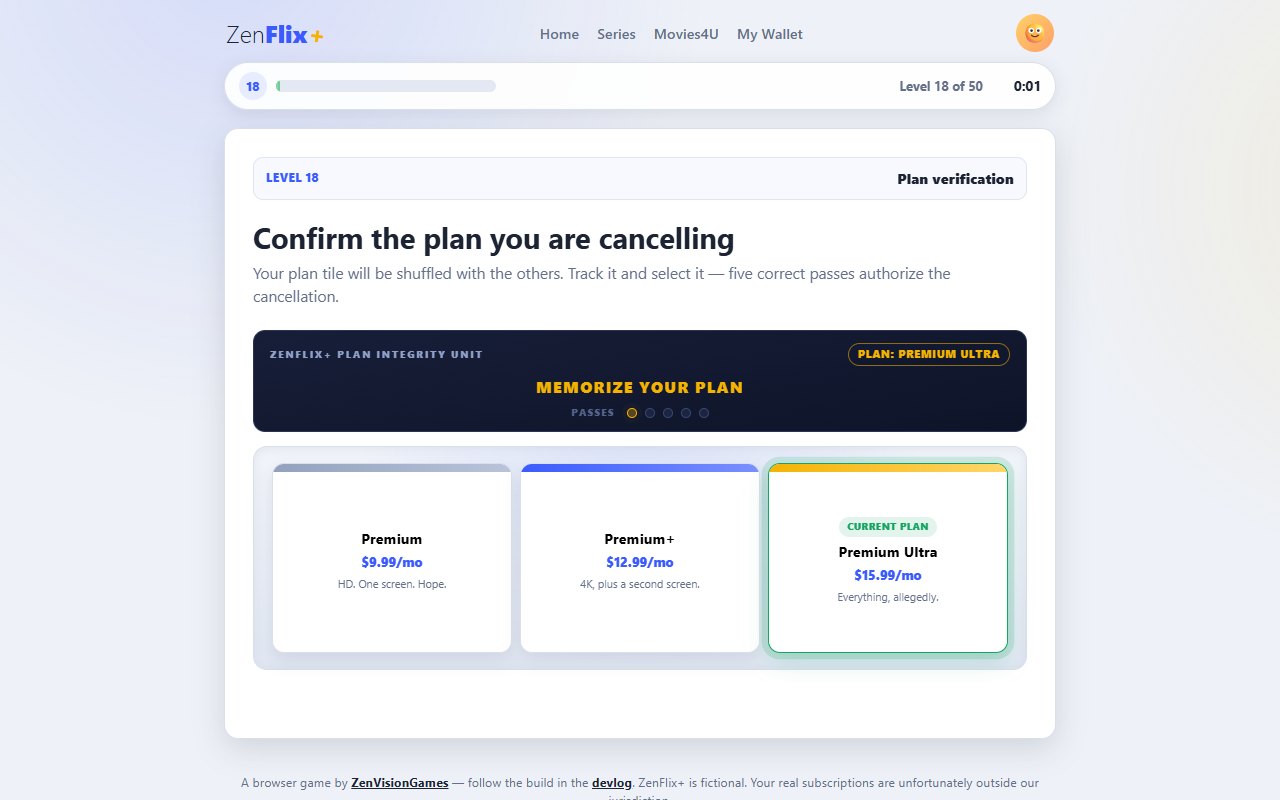
Level 18 begins with three plans: Premium, Premium+ and Premium Ultra. The player is shown the correct subscription, the cards turn over, and the plans shuffle. Track the correct one through five passes and the cancellation continues. Lose it and the verification starts again.
The satire starts with a familiar problem: product tiers with names similar enough to require careful reading. We then translate that uncertainty into a literal shell game. On the first pass the movement is readable. Later passes become faster and more elaborate, but the game never secretly changes the answer. The challenge is attention, not chance.
Level 19: every offer has a catch
Retention offers are useful when they are clear and genuinely optional. They become deceptive when hierarchy, wording or defaults make accepting effortless and declining uncertain. Level 19 turns that uncertainty into a seven-offer gauntlet.
Each screen presents a new reason to stay. The obvious button may accept a discounted plan. A reassuring confirmation may restart billing. The choice that actually declines the offer is still visible, but the player has to read what each action does rather than rely on colour, size or position. The order changes, so memorising "always click the bottom button" is not enough.
This level is closely related to interface interference: framing options so that the business-friendly choice appears more prominent. It also borrows from confirmshaming, where emotionally loaded language makes declining feel irresponsible, wasteful or antisocial. The joke works because the interface still looks polished and helpful while every sentence is negotiating against you.
Level 20: the smallest button is the authentic one
Level 20 moves from words to visual hierarchy. ZenFlix+ policy claims that the authentic cancellation control is always the smallest button. The player must compare pairs of near-identical controls and select the smaller one through eight rounds.
Early comparisons are obvious. Later differences become deliberately slight, forcing the player to judge dimensions rather than trust the visual prominence usually used to signal a primary action. The game presents the exercise as an official case file from the fictional Bureau of Dimensional Compliance, because apparently cancelling a streaming service now requires metrology.
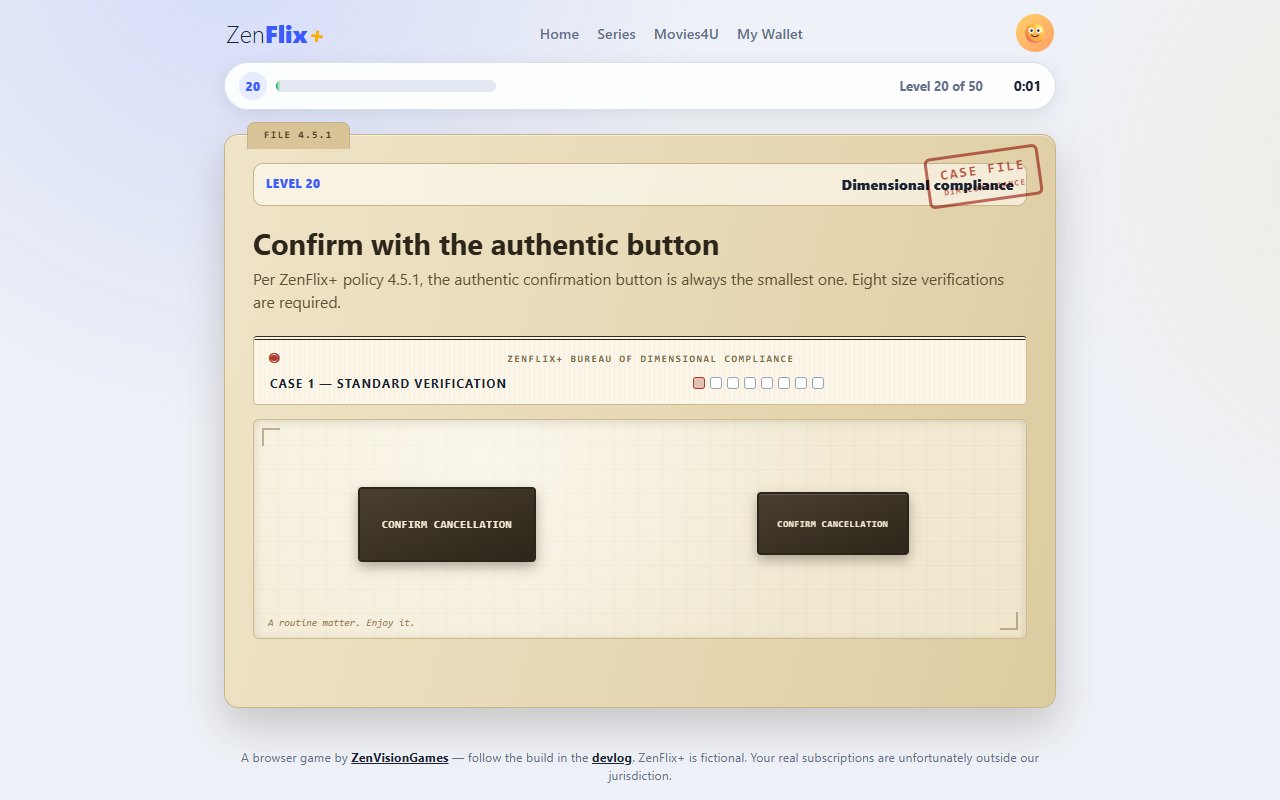
False hierarchy usually makes the preferred business option larger, brighter or more obvious. Level 20 reverses that convention and makes visual insignificance the rule. The absurdity comes from treating a manipulative layout choice as if it were a neutral, rigorously administered security procedure.
Levels 21 and 22: the button escapes, then multiplies
Once the player has proven they can identify the correct button, Level 21 asks them to contain it. The Cancel button moves to a new position every time it is approached or clicked. Each successful lock makes the next attempt smaller and faster until five locks finally contain it.
A moving target is an exaggerated form of obstruction, so fairness matters. The button stays inside the playable area, remains reachable on touchscreens, and follows rules the player can learn. We want the reaction to be "I cannot believe it moved again," not "the game ignored my input." That distinction is small in code and enormous in play.
Level 22 then changes the problem. Instead of one evasive button, the screen fills with copies. The original has a subtle visual tell; selecting a clone produces more clones. The player clears three batches of increasing size by finding the authentic control each time.
Button cloning is not presented here as a formal dark-pattern category. It is a visual metaphor for a cancellation flow filled with similar-looking actions: pause, downgrade, keep benefits, continue with cancellation, continue without cancellation, confirm the previous confirmation. When every control looks equally official, recognising the one that advances your goal becomes the puzzle.
Level 23: the retention conversation that branches forever
Level 23 brings the pressure into a chat window. The player meets three increasingly senior retention agents. Kayla offers empathy, discounts and concern about a 47-day viewing streak. Deborah has personally reviewed the account and can offer a better rate. Gary, the floor manager, appears to misunderstand the difference between cancelling and upgrading, then suggests a brief hold.
Every reply branches the conversation. Clear cancellation requests move the player forward. Engaging with offers and side questions raises a Retention meter. If it reaches 100%, ZenFlix+ cancels the cancellation and restarts the chat from the beginning. Even the final confirmation contains one last option that keeps the benefits active.
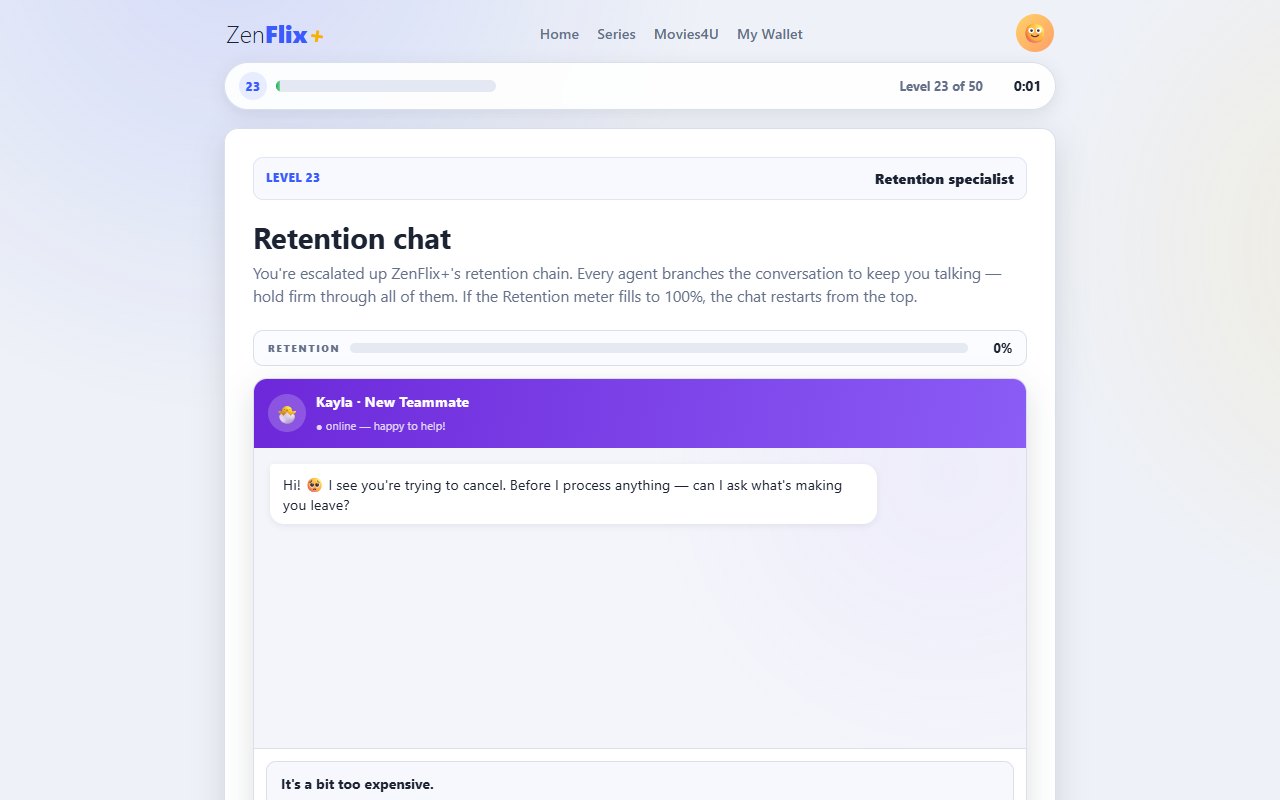
This level combines two documented ideas. Nagging repeatedly asks the user to take an action that benefits the business. Obstruction adds time, effort or complexity to the route the user actually chose. The conversational format makes both feel personal: a plain "cancel" request becomes something the player must defend against sympathy, urgency, discounts, lost credits and deliberate misunderstanding.
How do you make an intentionally frustrating game fair?
A game about hostile interfaces can easily become a hostile interface itself. That is the central design problem. The player should feel the joke without feeling that the game has cheated. For this batch, we use five practical rules:
- The correct action always exists. It may be small, moving or buried among copies, but it is never removed from the level.
- Failure follows a visible rule. The plan was lost during a shuffle, the larger button was selected, or the Retention meter reached 100%. We avoid hidden dice rolls that invalidate a correct choice.
- Difficulty escalates inside the level. The opening round teaches the mechanic before speed, quantity or ambiguity increases.
- Retries are immediate. Failure can be funny once; waiting through a long reset rarely is. The player should get back to the meaningful action quickly.
- Mobile is part of the mechanic, not an afterthought. Targets remain reachable, layouts reflow, and anything based on hover also has a touch equivalent.
These constraints are why an apparently simple gag can take longer to build than expected. A fleeing button needs boundaries. A shell game needs animation timing that remains readable on slower devices. A dense clone grid needs targets large enough for a thumb without making the original obvious. The humour appears on screen only after the interaction stops feeling accidental.
We break those constraints down further in our guide to making a hard game fun without making it unfair, including fast retries, mobile inputs and the difference between useful feedback and giving away an answer.
Why build this as a browser game?
The subject belongs in a browser. Subscription traps are made from familiar web controls: cards, forms, checkboxes, chat windows and buttons. Reusing that visual language lets the player understand each situation immediately, before the interface starts behaving badly.
It also keeps the game accessible. There is no download, installation or account. A link opens the game on desktop, mobile or tablet, and a level can be played during a short break. That is the broader goal for ZenVisionGames: small browser games and internet experiences that begin quickly, explore one strong idea and respect the player's time even when the fictional company inside the game does not.
What comes after Level 23?
Cancel My Subscription is still planned as a 50-level game. Reaching Level 23 means the project is approaching its halfway point, but the remaining levels cannot simply repeat the same trick with more buttons. Each batch needs a different interaction, a clear escalation and a reason to exist inside the world's most overengineered cancellation flow.
The next phase will continue mixing recognisable subscription friction with small arcade, memory, timing and dexterity mechanics. We will keep showing the work as it develops, including ideas that were rebuilt or removed because they were confusing rather than funny. That process matters: the final game should feel absurdly difficult because ZenFlix+ wants it that way, not because the controls are unfinished.
Play the game and follow the build
Play Cancel My Subscription free in your browser. There is no download, account or paywall, and the game works on desktop and mobile. The public build is updated in tested batches as development moves toward all 50 levels.
For the beginning of the project, read Devlog #1: 17 levels into dark-pattern hell. To report a bug or suggest a cancellation experience that sounds too ridiculous to be real, contact ZenVisionGames.