Making a game difficult is easy. Make the target smaller. Increase the speed. Add more steps. Remove information. Ask the player to do the same thing again. Any of those changes can raise the failure rate, but none automatically makes the game better.
The harder problem is how to make a hard game fun. A satisfying hard game lets the player understand the goal, learn the rules, recognise why they failed and believe the next attempt could work. A frustrating game takes away one of those things and calls the result difficulty.
We confront that line constantly while building Cancel My Subscription, a free browser game where a fictional streaming service makes cancellation absurdly difficult. The premise requires annoying the player on purpose. The implementation still has to be responsive, readable and fair across 23 very different levels.
See the rules in action. The first 23 levels are free and playable in your browser.
Play Cancel My SubscriptionThe short answer: challenge the player, not their patience
To make a hard game fun, keep the objective clear, introduce one rule at a time, escalate predictably, give immediate feedback, make failure recoverable and ensure the controls work consistently. Difficulty should come from applying what the player has learned. It should not come from broken input, hidden rules or waiting to retry.
| Hard but fair | Frustrating by accident |
|---|---|
| The goal is clear; the route is difficult. | The player cannot tell what the game wants. |
| Failure reveals something useful. | Failure looks random or unrelated to the input. |
| The rules stay consistent as pressure increases. | The game changes rules without communicating it. |
| A retry returns quickly to the meaningful action. | The player repeats solved work before trying again. |
| Mouse, touch and keyboard inputs are dependable. | The interface itself becomes the real opponent. |
Research supports a more nuanced view than "hard equals engaging." The influential GameFlow model connects enjoyment with concentration, challenge, player skills, control, clear goals and feedback. More recent research has questioned whether a perfectly matched difficulty-to-skill ratio alone predicts enjoyment. In practice, that means a difficulty slider cannot repair unclear rules or unresponsive controls. The whole interaction matters.
Rule 1: keep the goal obvious
A difficult route does not require a mysterious destination. In our game the objective never changes: cancel ZenFlix+. Every level explains the immediate version of that goal in plain language: reject the offers, reproduce the signature, find the original button, deliver the ball to the cancellation department.
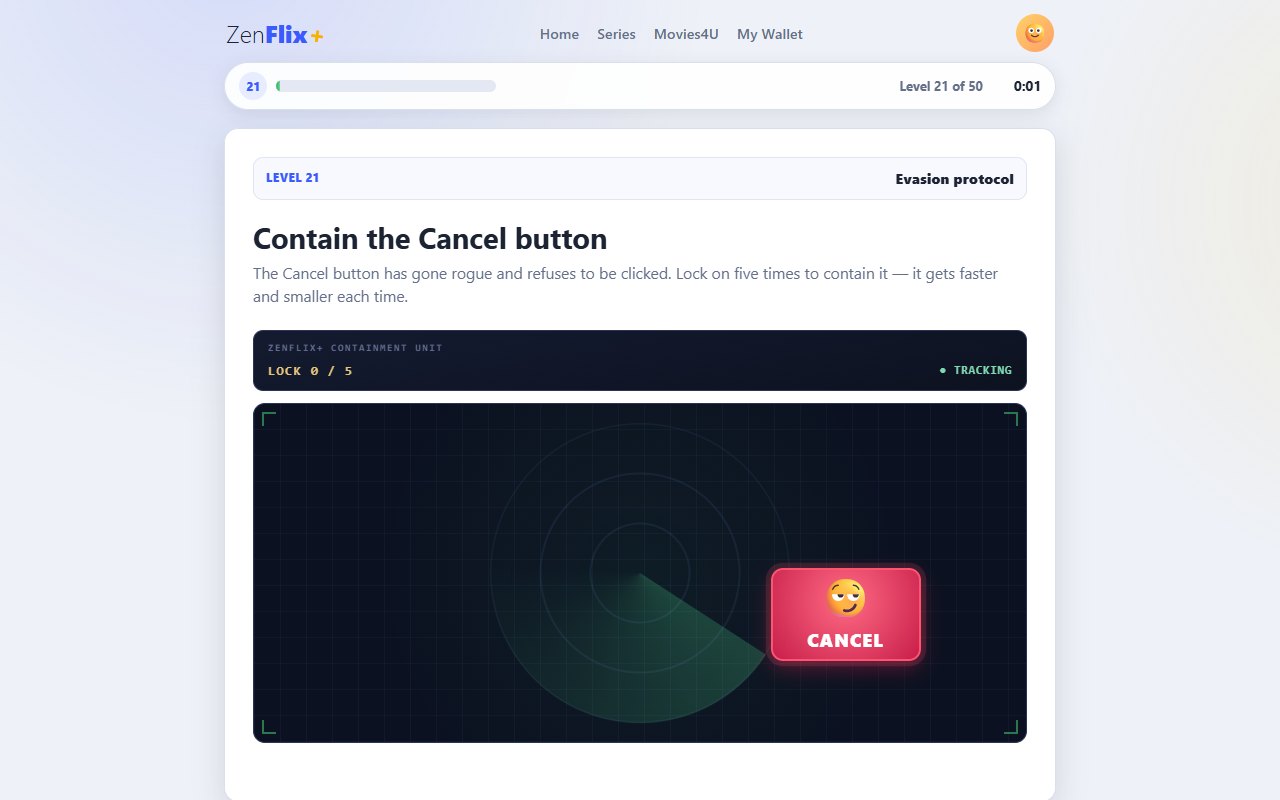
The fiction can be misleading. The task cannot be. Level 19 presents buttons with manipulative wording, but the fine print accurately describes the consequence. Level 21 lets the Cancel button flee around the screen, but the lock counter makes the target and required progress visible. The service is allowed to lie as a character. The game system still owes the player the truth.
This separation is useful in any puzzle or comedy game: make the situation strange, not the player's reason for interacting with it.
Rule 2: teach first, then escalate one variable
The opening interaction is the tutorial, whether or not it is labelled as one. Give the player a clean example of the rule before combining it with speed, quantity or pressure.
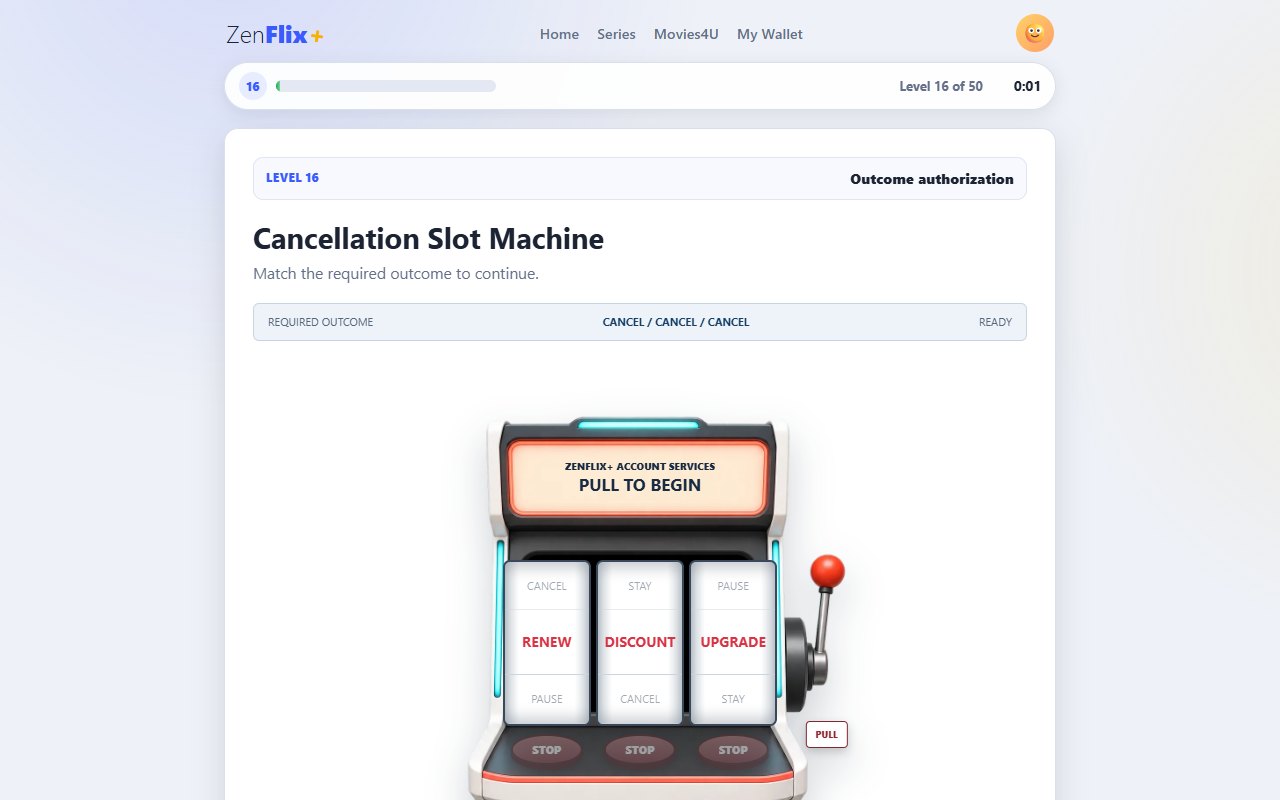
In Level 18, the player's Premium Ultra plan is highlighted before three plan cards shuffle. The first pass is slow enough to teach the tracking task. Later passes increase movement and complexity. In Level 16, the player stops three slot-machine reels. After each stopped reel, the remaining reels accelerate. The verb stays the same while one understandable variable becomes harder.
Escalating everything simultaneously makes failure difficult to diagnose. Increasing one variable preserves the lesson: the player knows what changed and what must improve.
Rule 3: make the rules consistent, even when the outcome varies
Randomness can create replayability, but hidden randomness often feels like theft. If a correct action can fail because of an invisible coin flip, the player cannot build a reliable mental model.
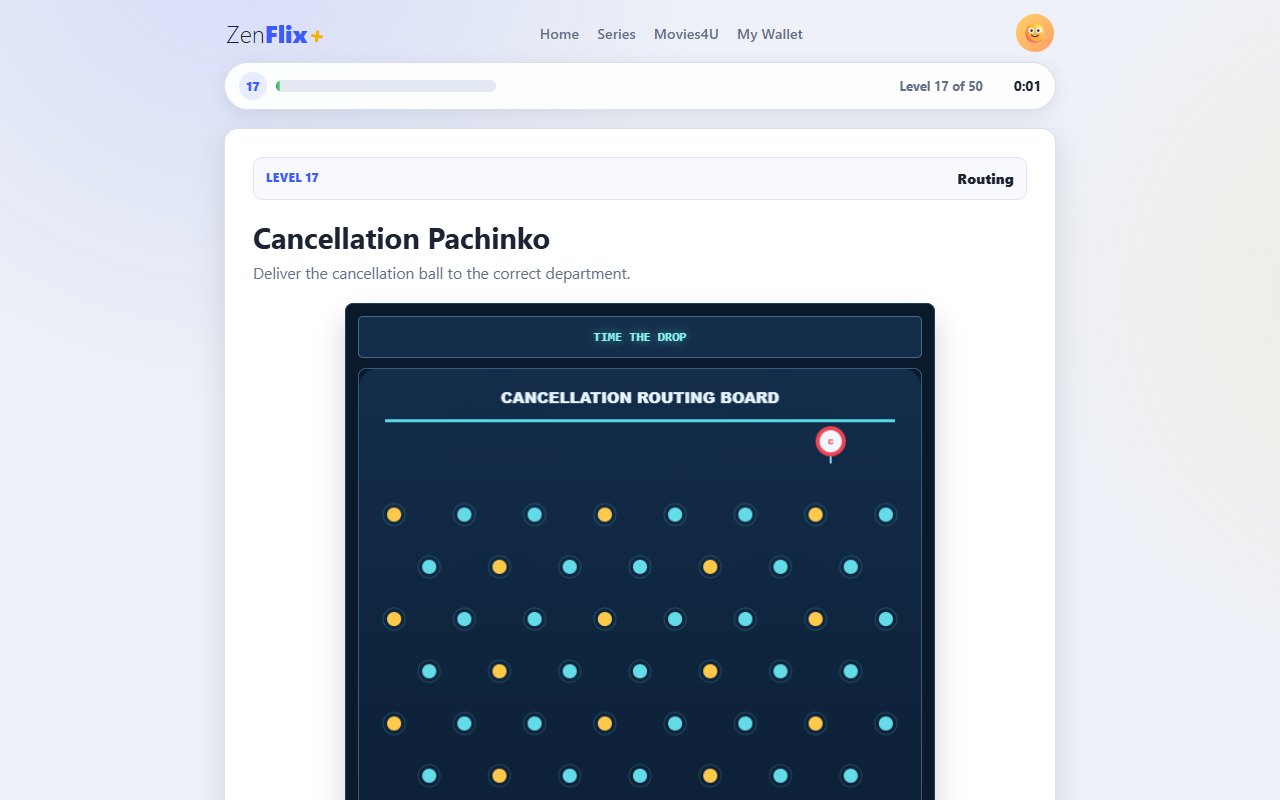
Level 17 uses real 2D physics, so the cancellation ball does not follow an identical path every time. The result is still grounded in visible input: the launcher moves from side to side, the player chooses when to drop, and the same board geometry handles the bounce. Variation comes from timing and physics rather than a secret success percentage.
Consistency also applies to visual language. If green means success on one screen, it should not silently mean danger on the next. A game may deliberately subvert a pattern, but it should communicate the new rule before testing mastery of it.
Rule 4: feedback should identify the problem, not solve it
Good feedback closes the gap between input and consequence. That does not mean exposing the answer. It means helping the player understand what kind of mistake occurred.
Level 5 contains dense cancellation terms, required acknowledgements, red-herring checkboxes and increasingly awkward date inputs. A failed submission keeps the message generic, because reading the clauses is part of the challenge. The relevant section pulses red so the player knows whether to inspect the acknowledgements or notarisation controls. The interface identifies the area of failure without revealing the exact box or date.
This is the useful middle ground between silence and spoon-feeding. Silence makes the player wonder whether the click registered. Showing the precise correction removes the puzzle. Directional feedback preserves agency.
Rule 5: make retries fast and preserve learned progress
The cost of failure is not only the lost attempt. It is every solved action the player must repeat before reaching the difficult part again. Long reset loops turn learning into administrative work.
On the slot-machine level, the player can pull the handle immediately after missing a reel instead of stopping the remaining reels first. The pachinko board resets the ball without reloading the level. The courtroom allows another statement submission after a mismatch; replaying the entire hearing is available, but not forced after a simple selection error.
A good retry starts immediately before the decision that needs improvement. If a longer reset is part of the intended stakes, it should be used deliberately and sparingly.
Rule 6: add new verbs, not only more steps
Difficulty curves become monotonous when escalation means doing the same interaction more times. Ten checkboxes are not automatically more interesting than five. A longer paragraph is not automatically a harder puzzle.
Across the first 23 levels, the player clicks, types, remembers a narrative, reads clauses, unticks a branching checkbox tree, solves CAPTCHA stages, draws a signature, searches receipts, assembles a packet, balances weights, plays whack-a-mole, guesses a phrase, tears calendar pages, stops slot reels, drops a pachinko ball, tracks shuffled cards and navigates a retention chat.
The common objective holds the game together; the changing verbs prevent the joke from becoming a form. When a level feels too long, the first question is not "what can we remove?" but "has the player already demonstrated this skill?" If the answer is yes, the next beat needs a twist or an exit.
Rule 7: use animation and sound to confirm physical cause and effect
Feedback is not limited to text. A button press should depress. A stamp should land on the document rather than float inside a modal. A dragged calendar page should follow the pointer while the frame remains still. A pachinko ball should click against each pin, make a different sound when it misses and trigger a full-screen celebration when it reaches the cancellation slot.
These details are often called game feel, but their first job is clarity. Motion and sound tell the player that the input registered and show what object caused the result. Once that communication is dependable, exaggeration can make the interaction funny and satisfying.
Rule 8: define difficulty around the weakest input method
A browser game can be played with a precise mouse, a laptop trackpad or a thumb covering part of a small phone screen. If a mechanic works only with hover or pixel-perfect pointing, it does not have one consistent difficulty level. It has an accessibility bug.
Our signature canvas uses pointer events so mouse, stylus and touch follow the same drawing model. Dragged receipts and calendar pages are constrained to their work areas. The moving Cancel button stays inside the visible containment field. Dense interfaces reflow rather than shrinking the entire desktop scene until the text becomes unreadable.
Mobile testing therefore happens while the mechanic is being designed, not after the desktop version is declared finished. Touch target size, finger occlusion, scrolling and accidental browser gestures all shape what "fair" means.
Safety valves do not have to make the game easy
A safety valve protects against a permanent block without erasing the challenge. Level 8 asks the player to reproduce a signature created earlier in the game. A live match percentage provides direction. After repeated failed attempts and clears, a faint trace of the saved signature begins to appear and becomes gradually clearer. A struggling player can eventually trace it instead of abandoning the game.
Not every level needs adaptive help. The hangman level keeps the same hard phrase after failure because every incorrect attempt teaches letter information and restarting is immediate. The right safety valve depends on why the player is stuck. Difficulty can stay high when learning is visible; assistance is more important when motor precision, memory loss or device limitations create the block.
Intentional frustration is a design material, not an excuse
A 2025 CHI paper examining 31 games argues that intentionally awkward, frustrating or failure-heavy experiences can produce meaningful play. That is an important permission, but not a waiver. "It is supposed to be annoying" does not excuse unclear interaction, broken responsiveness or inaccessible controls.
The useful test is simple: is the struggle itself the interesting part? Remembering a five-part courtroom story is the activity. Waiting for an animation you have already understood is not. Tracking a shuffled card is the activity. Guessing whether the tap registered is not. Drawing a signature is the activity. Fighting the browser's touch scrolling is not.
We have rebuilt levels when they failed that test. The notary inputs changed because dropdowns became monotonous. A printer puzzle was replaced by a slot machine because its interaction was unclear and visually cluttered. The first mobile whiteboard layout was not "deliberately awkward"; it was simply wrong. Intentional frustration only works when accidental frustration is removed first.
Play the example
The easiest way to evaluate these rules is to play them. Cancel My Subscription is free in your browser, with 23 levels available on desktop, mobile and tablet. There is no download, account or paywall.
For more on the subject behind the game, read why cancelling a subscription is deliberately difficult. For a detailed tour of the newest mechanics, see six subscription dark pattern examples turned into game levels. For the technology behind the format, read how no-download browser games work.
Research and further reading
- Sweetser and Wyeth: GameFlow, a model for evaluating player enjoyment in games
- Difficulty-skill balance does not affect engagement and enjoyment: a pre-registered study
- Monash University: This Game SUX, intentional frustration and non-normative game design
- Game Developer: Designing for difficulty through readability